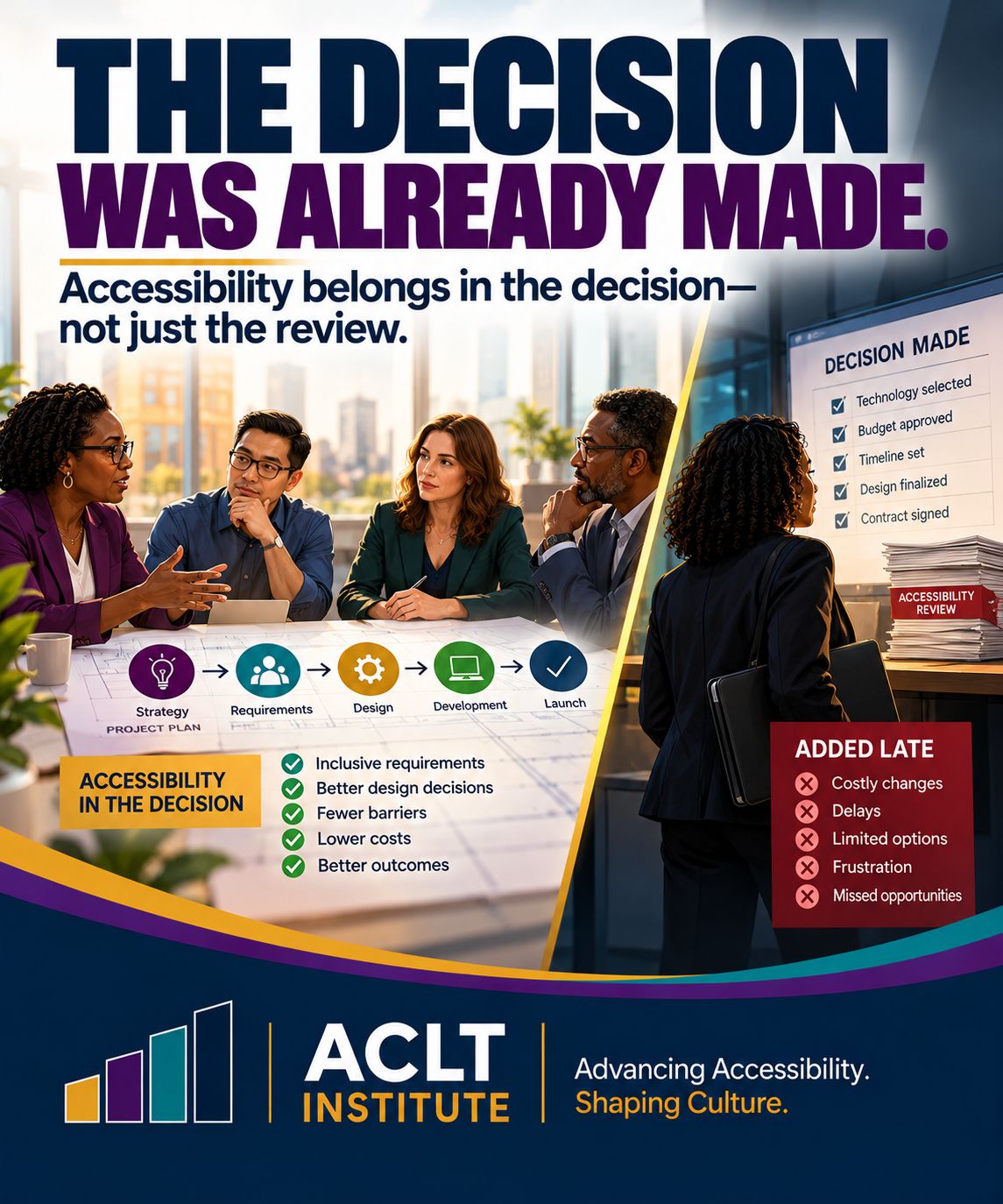
ACCESSIBILITY WASN'T OVERLOOKED. IT WAS INVITED TOO LATE.
Consider how many organizational decisions shape accessibility long before anyone evaluates a product.
Technology is purchased.
Budgets are approved.
Project timelines are established.
Design requirements are finalized.
Then someone asks:
“Has accessibility reviewed this?”
By that point, the most consequential decisions may already be difficult or expensive to change.
This is why accessibility governance must extend beyond policies, standards, and compliance reviews.
Governance determines when accessibility influences decisions, who has authority, and how accessibility requirements are integrated into organizational processes.
Within Accessibility Culture Leadership Theory (ACLT), this raises an important distinction:
An organization can have accessibility policies without having accessibility embedded in its decision-making culture.
The objective isn't simply to identify barriers earlier. It's to establish organizational practices that prevent those barriers from being designed into the system in the first place.
Accessibility shouldn't have to fight its way into decisions after they're made.
It should help shape them.
ACLT Institute
Advancing Accessibility. Shaping Culture.
#ACLTInstitute #AccessibilityLeadership #AccessibilityGovernance #AccessibilityCulture #DigitalAccessibility