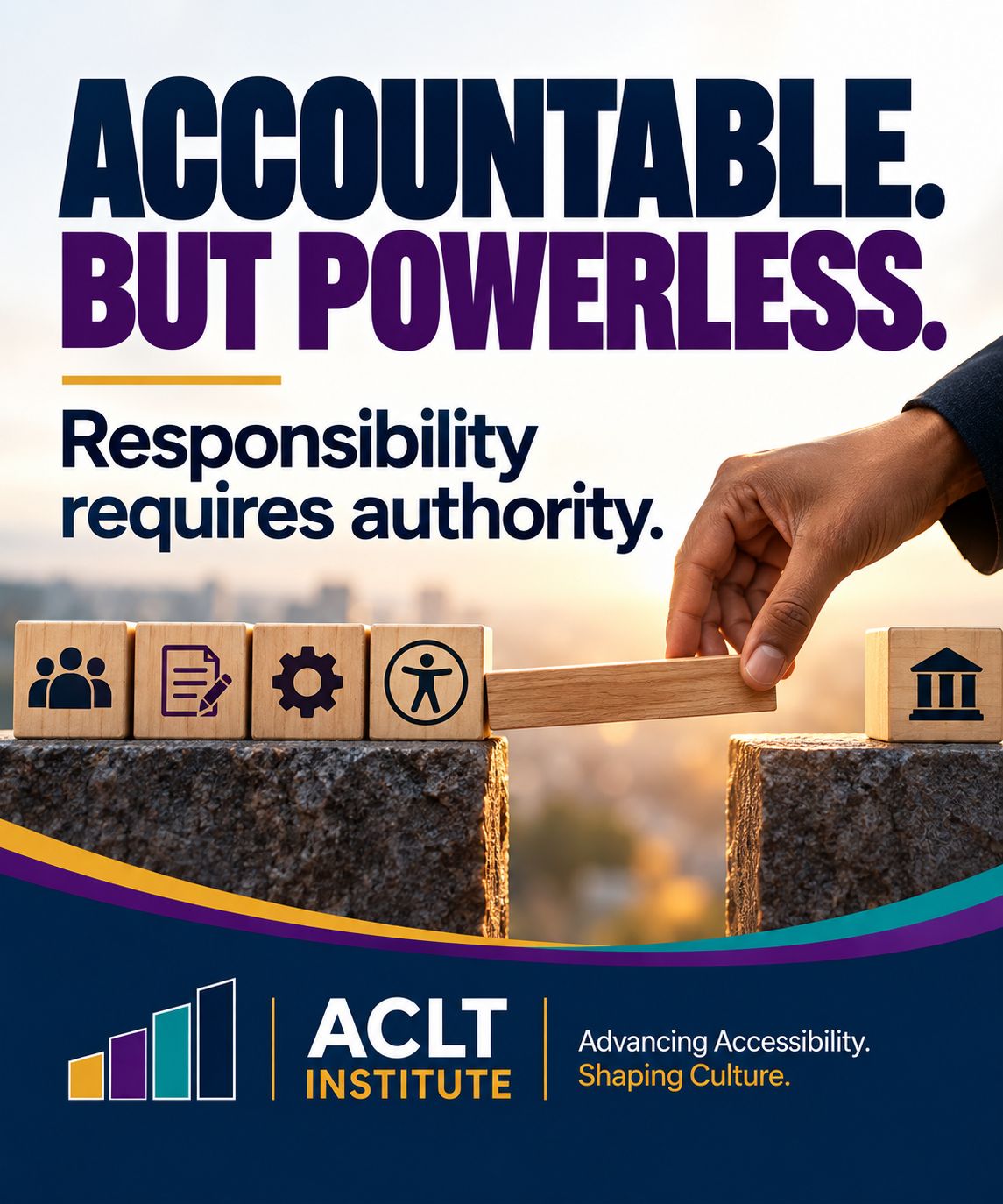
You gave them responsibility. Did you give them authority?
Organizations are increasingly recognizing that accessibility cannot belong to one person or department.
That's progress.
But assigning responsibility is only the beginning.
Consider a product team that's accountable for accessibility but cannot influence release decisions.
Or a content team expected to produce accessible documents without adequate training, tools, or time.
Or an accessibility leader responsible for organizational outcomes but excluded from strategic decisions.
Responsibility without authority creates accountability gaps.
Sustainable accessibility requires more than clearly defined roles.
It requires organizational conditions that enable people to fulfill those roles.
That means aligning decision-making authority, resources, capabilities, and accountability.
Within the emerging Accessibility Culture Leadership Theory (ACLT) framework, this distinction matters.
Accessibility becomes part of organizational culture when people are not only expected to act but are empowered and supported to do so.
We cannot build accountability into a system that withholds the ability to act.
What authority does your organization give the people it holds responsible for accessibility?
ACLT Institute
Advancing Accessibility. Shaping Culture.
#ACLTInstitute #AccessibilityLeadership #AccessibilityCulture #OrganizationalLeadership #DigitalAccessibility